Conversational AI assistants like ChatGPT are becoming a core part of people’s daily lives, including helping them research and discover new products and services. But most consumers are yet to fully trust AI.
A poll of UK consumers I commissioned for CloudNine PR reveals that:
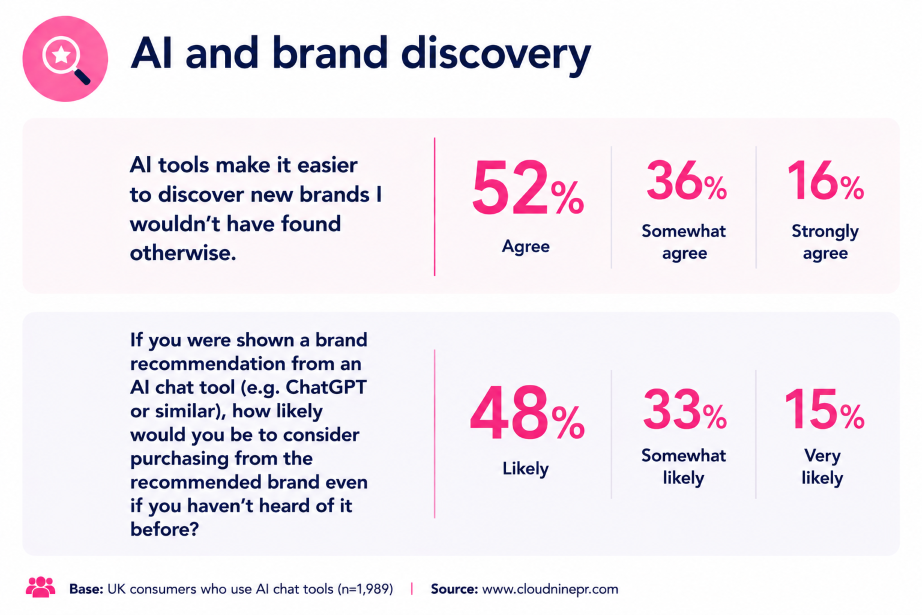
- 52% of those who use AI chat tools say AI makes it easier to find new brands they might never have found otherwise.
- But 79% would still want to check other sources before trusting AI recommendations
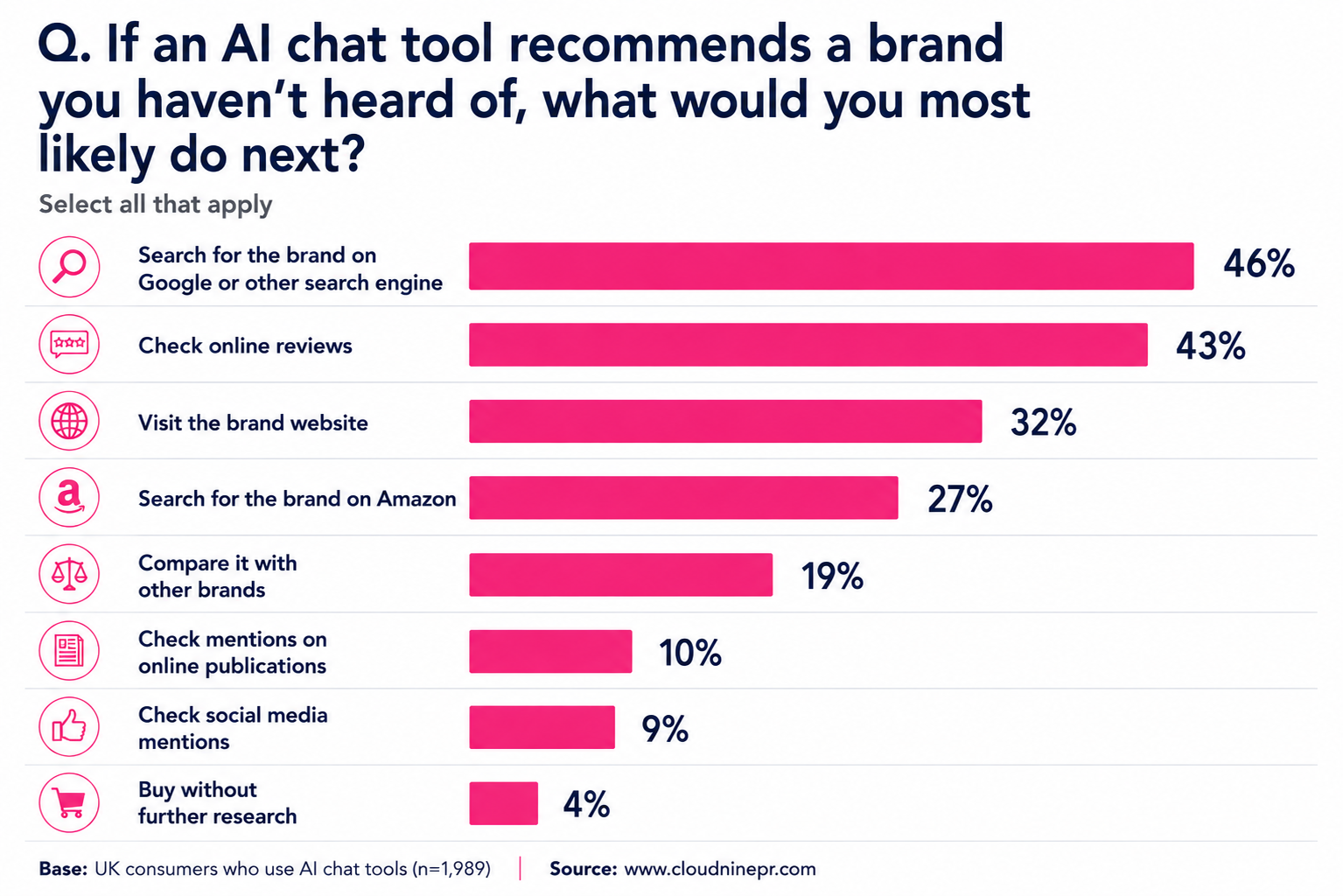
- Only 4% would consider buying an unfamiliar brand recommended by AI without validating it elsewhere. They would check on search engines, online review sites, the brand website, mentions on online publications, and social media.
- With Google and OpenAI pressing ahead with the rollout of advertising in their AI tools, and rivals Anthropic and Perplexity standing firmly against ads, 63% of AI users say that if a tool started showing ads, they would likely switch to an alternative that doesn’t.
The survey of 2,564 UK consumers suggests that 78% of people now use AI chat tools like ChatGPT. The research explores how these conversational AI assistants are changing the way people find products and services and shop online, how much trust they have in AI recommendations, and how their level of trust is affected when they see ads integrated into AI responses.
1. How does AI improve product discovery?
AI is turning into a powerful discovery channel that is helping people find products and services. 52% of consumers who use AI chat tools agree that they make it easier to discover new brands they wouldn’t have found otherwise. And 48% would consider buying from a brand recommended by AI even if they hadn’t heard of it before.
So, AI is exposing people to new products and services and potentially helping lesser-known brands compete more effectively with established brands.
2. Do consumers trust AI recommendations?
The survey suggests there is currently a level of cautious trust in the products and services that are recommended by AI.
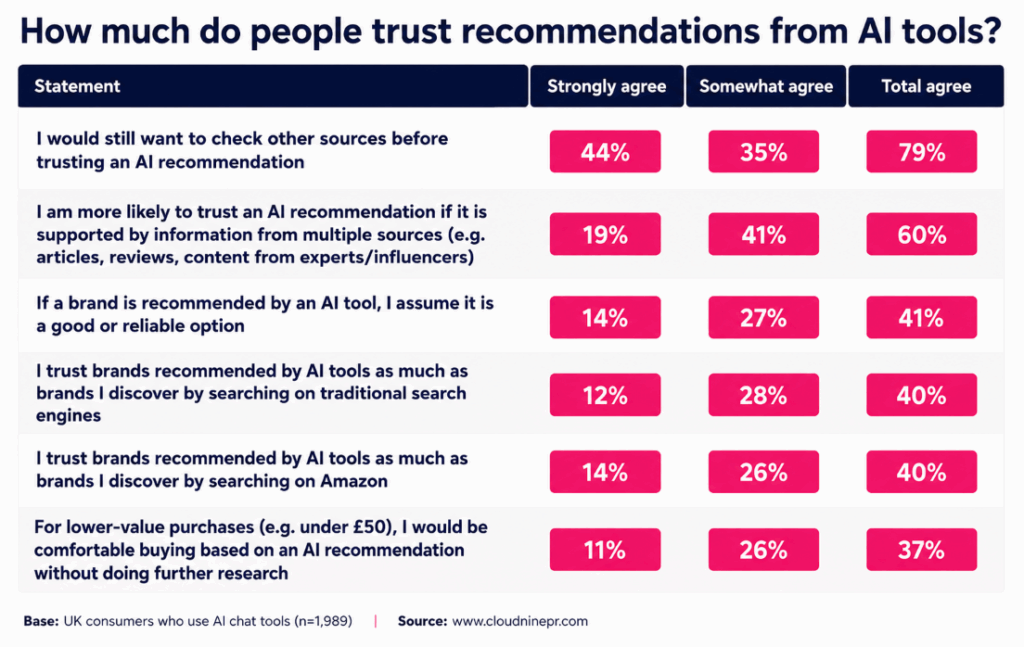
41% of consumers who have used AI assistants assume that brands recommended by AI will be a good or reliable option. 40% now trust AI recommendations as much as those they find on traditional search engines such as Google. The same proportion (40%) trust them as much as products they find via Amazon searches.
But 79% would still want to check other sources of information before completely trusting an AI recommendation. Although for smaller purchases (those under £50), 37% said they would consider buying AI recommended products without any additional research.
Most people still want the reassurance of seeing where AI is getting its information. 60% say they’re more likely to trust AI recommendations if they are supported by multiple sources such as the articles, reviews and influencer content that underpins them. They are not blindly accepting what AI says.
3. How does AI fit into the discovery journey?
The research suggests that for many consumers, AI is turning into the starting point of a longer buying journey.
Because AI recommendations are rarely viewed in isolation. Only 4% of people who use AI chat tools would consider making a purchase straight away when the AI recommends an unfamiliar brand.
Instead, consumers are using AI as part of a broader research process. When they see an AI recommendation for an unfamiliar company, they try to validate it by looking elsewhere. 46% would check on Google or other search engines, 43% would check online reviews, 32% would visit the brand website, 27% would search on Amazon, 10% would check mentions on online publications and 9% would look for social mentions.
AI is operating less as a replacement for search, reviews, marketplaces, media, social sites and other channels and more as an additional layer in the discovery journey.
4. Will ads reduce trust in conversational AI assistants?
Both Google and OpenAI are expanding the use of advertising (in Google AI mode and in ChatGPT), but ads are not yet widespread in either. So the question remains: can AI tools be successfully monetized through advertising? And will seeing ads damage the user experience and reduce consumer trust in AI?
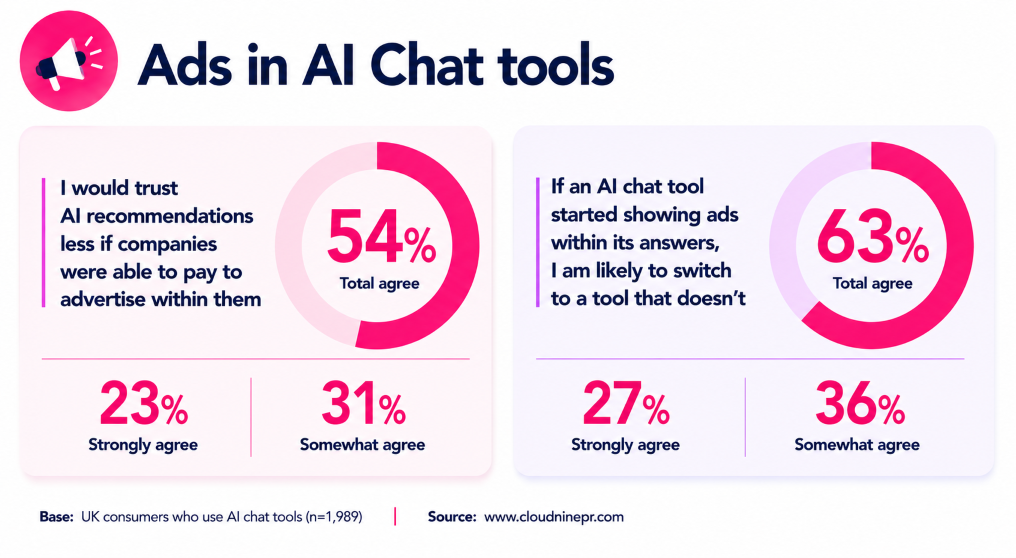
According to the survey, 63% of UK consumers who used AI assistants agree (27% strongly) that if they start seeing ads in a tool they are using, they would likely switch to an alternative that doesn’t. Over half (54%) say they would have less trust in AI recommendations if companies are showing ads within them.
Some of these numbers back up the findings of a February 2026, US survey by IPSOS in which 63% of consumers either strongly (27%) or somewhat (36%) agreed that ads would reduce trust.
The leading AI companies are taking very different approaches to advertising, falling clearly into pro and anti-advertising camps:
- Google initially introduced ads to its AI mode last year and has recently announced that it is testing new conversational ad formats.
- OpenAI began testing advertising on ChatGPT with a select number of US advertisers in January. It is gradually expanding this pilot to more countries (including the UK) and to more advertisers. Along with launching a self-service ad manager (initially in the US) and improving its measurement tools, the company is introducing cost-per-click (CPC) ads to allow advertisers “to align their spend more directly with the actions people take after seeing an ad”.
- Anthropic has taken a clear stance against introducing ads to its Claude AI assistant, vowing to keep its AI conversations an ad-free zone: “Our users won’t see sponsored links adjacent to their conversations with Claude; nor will Claude’s responses be influenced by advertisers or include third-party product placements our users did not ask for.”
- AI search provider, Perplexity, initially experimented with advertising on its chatbot, but announced earlier this year that it is abandoning ad-based monetisation: “The challenge with ads is that a user would just start doubting everything . . . which is why we don’t see it as a fruitful thing to focus on right now.”
Conclusions
- AI chat/conversational assistants are rapidly becoming a discovery channel that consumers are using to find out about products and services.
- These tools are helping lesser-known brands get noticed – those that people might never have come across otherwise.
- Consumers are beginning to trust AI enough to consider acting on its recommendations, although most still want to see the supporting sources that AI tools pull information from (media articles, reviews, expert/influencer content, etc.). They also check alternative channels (search engines, reviews, Amazon, media and social mentions) to verify what AI is telling them. Meaning companies still need to actively drive their PR and SEO efforts to ensure visibility in traditional online media, search, social media, and user-generated content (UGC).
- While the likes of Google and OpenAI are moving ahead with plans to roll out ads (in AI mode and ChatGPT), the research suggests that displaying ads risks undermining consumer trust. These findings support the approach taken by companies such as Anthropic and Perplexity, who stand firmly against showing ads to avoid losing consumer trust.
About the research
CloudNine PR commissioned market research company TLF Research to conduct the survey of 2,564 UK consumers, 1,989 of whom use AI chat tools. The data was collected during April 2026.
Featured image photo by Saradasish Pradhan on Unsplash