
If you want to learn the secrets to effective PR – especially media relations – then you can gain a lot of value just from paying close attention to what journalists say about PR on social media. They’re essentially giving away valuable PR tips for free!
With this in mind, here’s the latest in my occasional roundups of the PR tips and advice that journalists have shared on LinkedIn recently. This is based on posts I’ve spotted on my timeline over the summer months.
1) Always ‘Move the story forward’
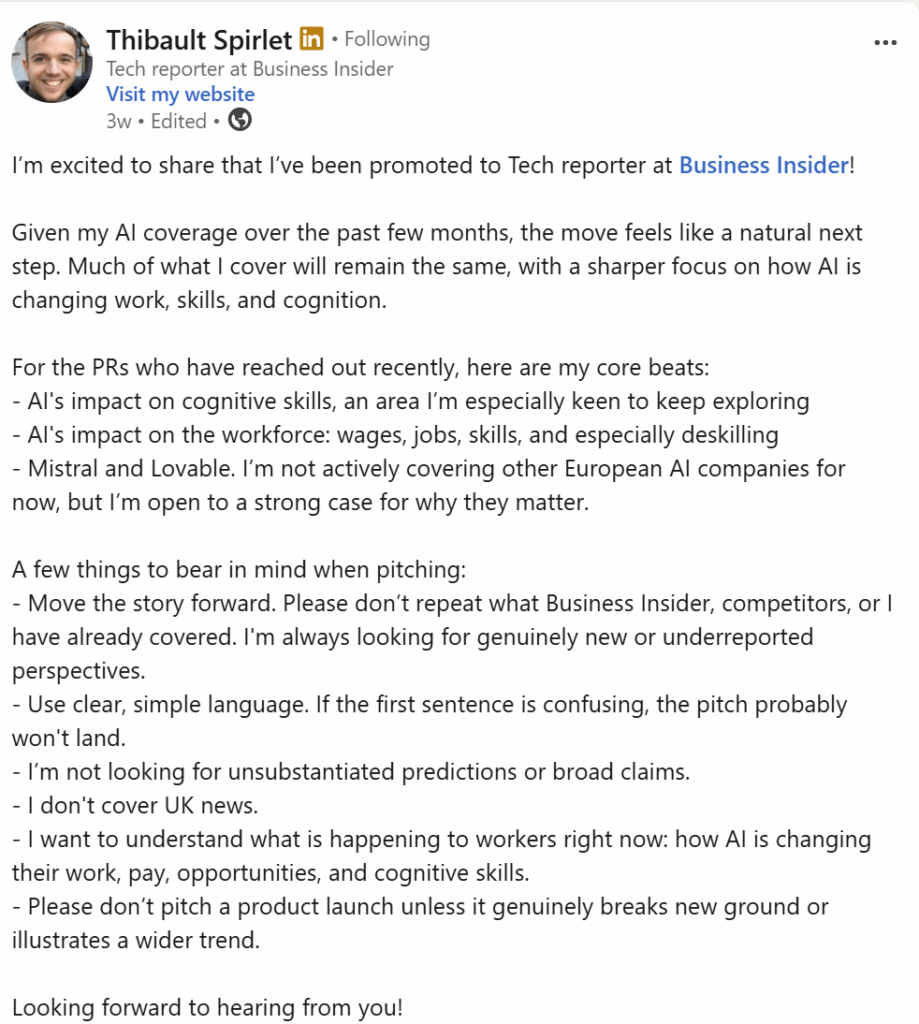
Business Insider Tech Reporter, Thibault Spirlet, shares a variety of pitching tips that are great reminders for anyone pitching B2B technology stories. One tip he gives is always to ensure “move the story forward” i.e. be careful not to repeat what’s already been said elsewhere in the media.
This is particularly relevant to PR’s pitching comments or interviews on a trending topic or an evolving news story (reactive commentary or newsjacking).
For example, if a big brand retailer’s customer service AI is in the news for dishing out incorrect advice to customers, then pitch an expert who can move the story forward. Can they discuss the guardrails that retail customer service AI systems need? Or do they have evidence or data showing that AI customer service bots are damaging customer loyalty?
2) Don’t rush freelance journalists (give them extra time)
Freelance journalist Kinanzi Constable, who’s had articles published in the likes of Inc., CNET, Fortune and Business Insider, suggests that PR people are forgetting how freelancers operate. They’re not allowing enough time before chasing freelancers about story ideas.
“When you’re following up within 72 hours, there’s close to zero chance a freelance journalist has heard back from their editors,” says Kinanzi.
Most PRs should know that a freelancer will typically have to first pitch ideas they receive from PRs to an editor – and then to wait until their pitch is accepted by that editor before starting work on the final piece. So, wait a bit longer before pushing freelance journalists about whether they want to use your idea.
3) Don’t hide your media contact details (or you could miss out on ‘easy’ media opportunities)
Both Katie Deigton of the Wall Street Journal and Joanna Fantozzi of Nation’s Restaurant News decry the fact that companies are failing to publish contact details for their PR people/media contacts on their websites.
Joanna describes how time-poor journalists are likely to pass up a company they would prefer to interview for a second-choice company – simply because that second-choice company made their contacts easier to find.
Katie describes the frustration of having to trawl through old PR Newswire press releases just to find contact details.
The bottom line? The media section on your website should have an easy-to-find media contacts section with names, emails, and ideally direct telephone numbers.
4) Don’t get too pushy with follow-ups!
How rapidly should you follow up your original journalist pitch? And what is the right way to do it? These remain hotly debated issues among media relations experts and journalists.
Orlando Crowcroft’s repost of Kimanzi Constable’s original post is a perfect example.
Orlando is happy for PRs to send follow-ups because “I don’t think I have ever replied to a pitch first time s” (although he does specify a maximum of two follow-ups).
Kimanzi, on the other hand, is hitting back at “pushy PR pros” who follow up too aggressively, insisting on a response by a given deadline. “That’s an instant delete,” according to Kimanzi.
My experience is that individual journos have different preferences on this. SO, there’s no one-size-fits-all advice. But in general, two follow-ups max is a good rule to adhere to. And in each follow-up try to add more insights or additional facts so that you are giving the journalist more information to assess the relevance of your pitch.
5) Stop pitching ‘casual’ journalist meetups at big shows
Don’t ask editors to arrange “casual meet and greets” at major international conferences, warns Aaron Mehta at Breaking Defense magazine. Because journos just don’t have the time at these events, he suggests.
Aaron received some pushback in the comments for suggesting that PRs are peppering journalists with emails asking if they want to meet “this small company you’ve never heard of” while attending shows.
To be fair, Aaron clarifies that it’s not that he doesn’t value these kinds of meetings; but he feels that the big shows – which are some of the busiest times for editors – are just not a good time to to do it.
In my experience, if you want to pitch journalist meetings at huge events, you really must have a compelling story or issue -or a top-notch spokesperson that’s otherwise difficult to access. Because you’ll be competing with so many others.
Even if you do manage to arrange a meeting, whether it actually happens as planned is often a lottery. Journalists can easily get sidetracked or delayed because there’s so much going on. You must be flexible and prepared to adjust to last-minute changes to timings and logistics.
Photo by Kristina Flour on Unsplash